
Porous Carbon
Porous carbon for silicon–carbon anode material development. Discuss your deposition process and sample requirements with Haina.
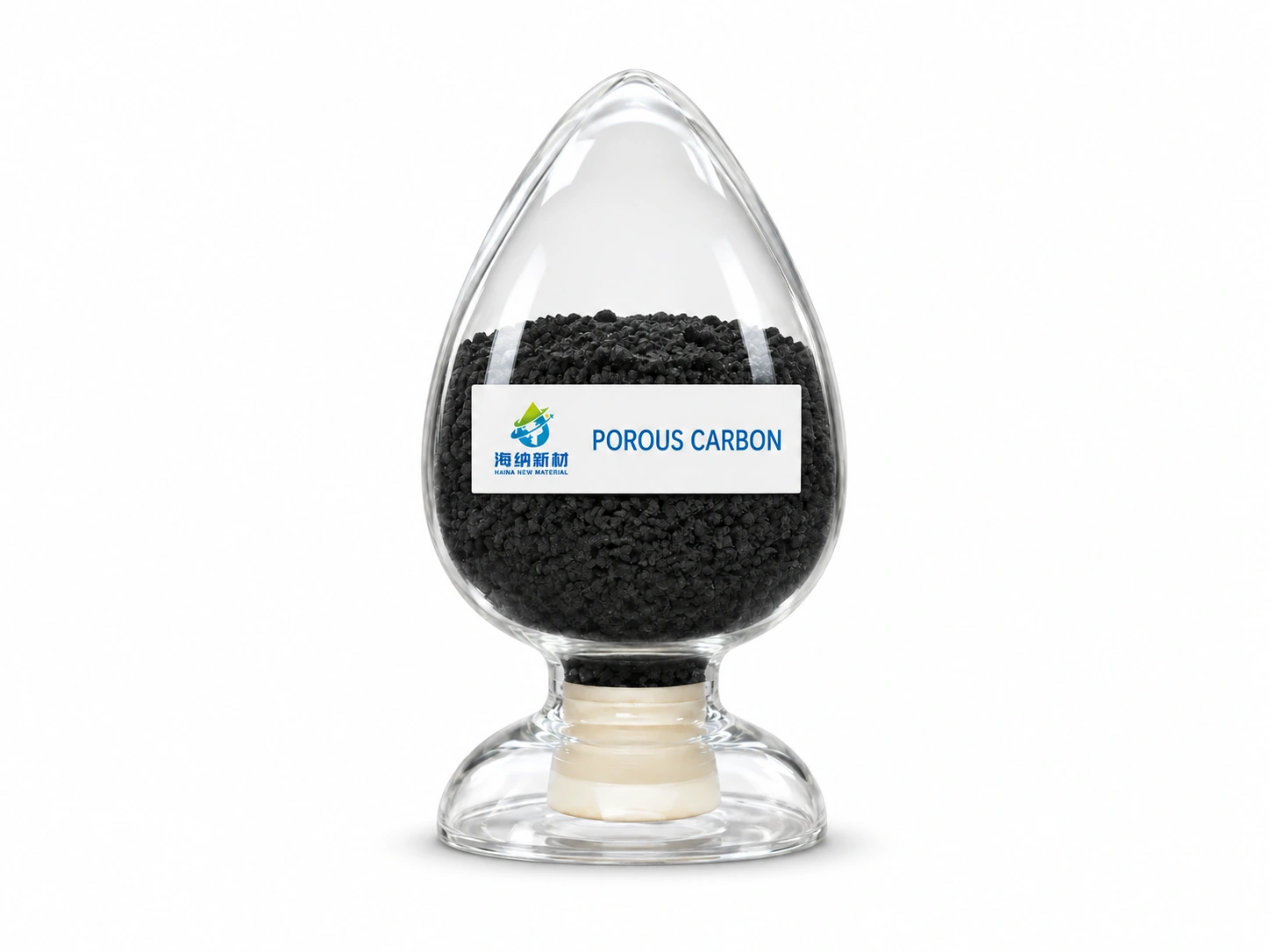
A porous carbon host for silicon–carbon anodes.
In vapor deposition routes, accessible pores give silicon space to deposit within the carbon host. The required pore profile depends on the deposition route and the electrode design.
Product Overview
Industry Applications

01 · BATTERY MATERIALS
Silicon–Carbon Anode Research
Anode material developers evaluate porous carbon as a host for silicon in lithium-ion battery materials. Research teams compare candidate carbon grades against their target material properties.
Typical screening inputs include particle size, pore volume, target silicon loading and sample quantity. The photo shows representative laboratory equipment.

02 · BATTERY DEVELOPMENT
Lithium-Ion Cell Development
Battery R&D teams evaluate silicon–carbon electrodes in laboratory cells before committing to pilot production. Coin-cell testing is one way to compare material candidates under consistent conditions.
Share the intended cell format and evaluation targets when requesting samples or current material data.
Where Haina Fits
Silicon–Carbon Anode Research
Share your deposition route, target pore profile, particle size and planned silicon loading.
Lithium-Ion Cell Development
Describe your formulation, cell format, performance targets and sample quantity when requesting material information.
Photo credits
UCL Faculty of Mathematical & Physical Sciences · CC BY 3.0 · resized and cropped in display

UCL Faculty of Mathematical and Physical Sciences · CC BY 3.0 · resized and cropped in display

Discuss Your Material Requirements
Share your target pore profile, particle size, deposition route and sample requirements.